How a rooflight rain sensor works
The sensor has one job: to notice water. Its sensing surface is a small plate or grid, and when droplets bridge it, the electrical behaviour of that surface changes. The sensor passes a signal to the control unit, and the control unit drives the actuator to the closed position. The whole sequence takes the time the motor needs to bring the sash down, which is why manufacturers' documents describe it as automatic closing rather than instant closing.
Many designs warm the sensing surface slightly. That keeps morning dew from reading as rain and dries the plate once the weather clears, so the sensor can reset itself. The manufacturer's data sheet for the model we specify states how it behaves, and we quote that sheet in the job plan rather than describing it from memory.
The sensor does not decide when to reopen. Once the plate is dry, most systems simply wait for the next instruction from a switch, remote or timer. That is deliberate: a rooflight that reopened itself every time the sun came out would be as irritating as one that never closed. Treat the sensor as a safety net that shuts the door, and the controls described below as the way you open it again.
Will an electric rooflight close automatically when it rains?
It will if it has a rain sensor connected, and the sensor is working on a powered circuit. An electric opening rooflight does not close itself just because it is electric. The motor moves the sash when the controller tells it to, and the rain sensor is one of the things that can give that instruction. Without a sensor, closing is a manual action from a switch or remote.
Some manufacturers supply the sensor as part of the package, and some list it as an option fitted to the frame or the control box. We confirm at the survey whether the unit you want comes with one, because adding a sensor to a unit that was ordered without it can mean a different controller. The job plan therefore lists the sensor as a named line, so there is no doubt about what has been ordered.
Two limits are worth knowing before you rely on automatic closing. A sensor reacts to water on its own surface, so a gust that blows rain sideways onto a cill but not onto the plate may close the unit a little later than you expect. And a sensor needs power: how the system behaves during a mains failure is covered in our guide to an electric rooflight in a power cut.
- A skylight rain sensor connected to the controller
- Mains or battery power available at the controller
- An actuator with free travel to the closed position
- A sash that is not obstructed by a blind, plant or furniture
- Settings confirmed on handover
Where is the rain sensor on a rooflight?
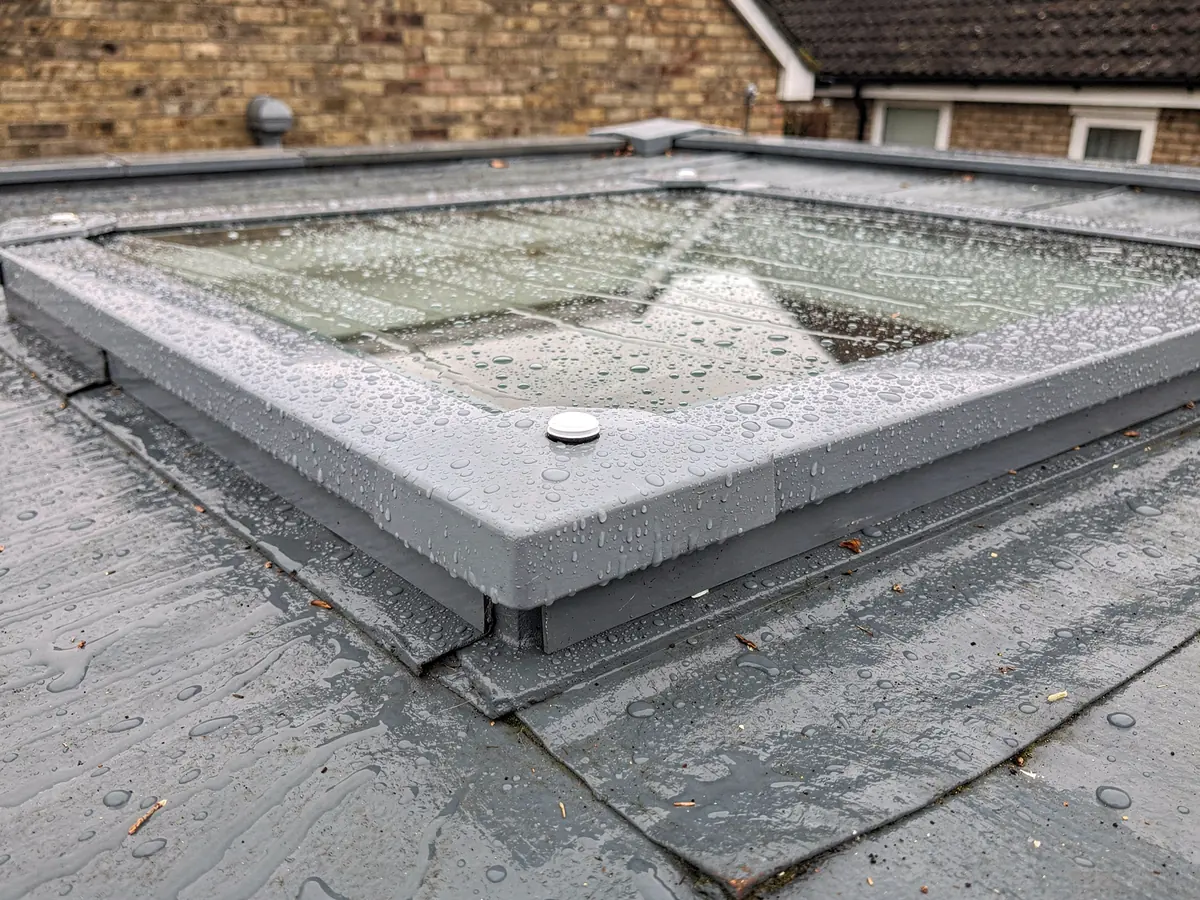
The sensor sits where rain will reach it first and where it is not shaded by the sash itself. On a flat rooflight that usually means the outer frame or the upstand, set on the top face so that falling rain lands directly on the plate. On a pitched-roof electric roof window, the sensor often sits in the top part of the frame or on a short arm beside the window. The photograph shows a skylight rain sensor on the frame of a closed flat unit, which is the most common arrangement.
The cable then runs from the sensor to the control unit. On a new extension that run is usually concealed in the build before the ceiling is closed, and on an existing roof it follows a short route through the upstand lining or the reveal. Where the cable goes is a survey item, because the route decides whether the finish inside needs any opening up.
The placement matters for a practical reason. A sensor in the shade of an overhanging parapet or a tall wall reads rain late. One set below a tree that drips for an hour after a shower may keep the unit shut longer than you would like. We look at the roof's surroundings at survey and note any shading in the job plan so the position is chosen deliberately.
Wall switches, keypads and remotes
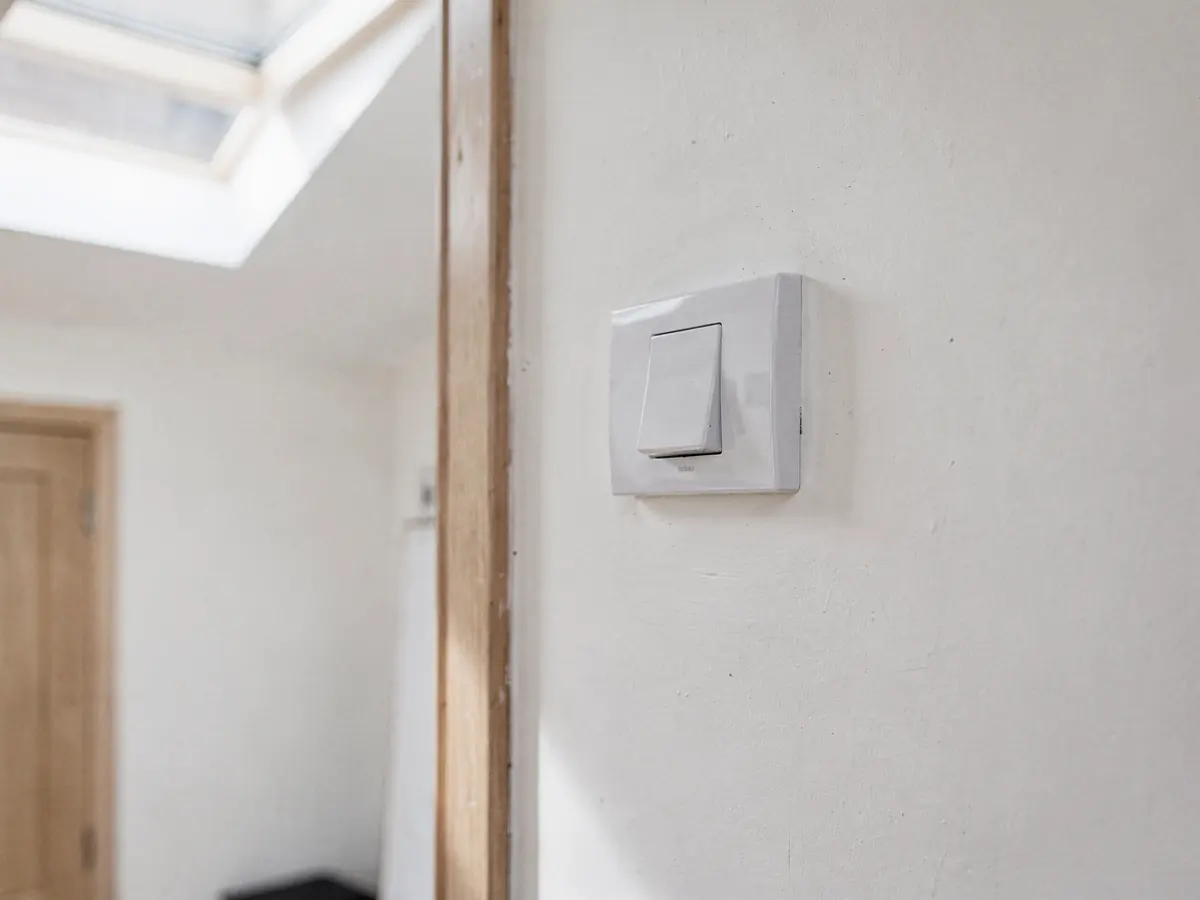
Every electric opening rooflight needs a way for a person to give it an instruction. The simplest is a wall switch or keypad on the wall of the room below, usually with up and down buttons and sometimes a stop position part way. Placing it near the door or beside the existing light switches means it is found by habit, which is how a rooflight gets used rather than forgotten.
A handheld remote does the same job without wiring a fixed control to the wall. It suits a room where a keypad would clash with the finish, or where the rooflight is above a stair and the switch would be out of reach. The remote and the controller are paired during commissioning, and a spare remote is worth keeping in a different room from the first.
Several units can share one control. Two rooflights over a kitchen extension are normally set to move together from one keypad, or to move separately if the room's layout asks for it. We settle the grouping on the survey visit and put it in your plan, since changing it afterwards means setting the controller up again.
Can an electric rooflight be controlled from a phone?
Yes, where the manufacturer offers a compatible gateway or app. Most control systems for opening rooflights have an optional module that joins the controller to home wifi, and from there to an app or to a smart-home hub. The app then offers the same instructions as the keypad: open, close, stop and sometimes a set position.
Smart-home links are a layer on top of the basic controller, not a replacement for it. If the wifi drops, the wall switch and remote still work. We treat the app as a convenience and make sure the physical controls always stay in place. Compatibility with a particular hub or voice assistant varies between manufacturers and changes as software is updated, so we read the current manufacturer's documents at the time of quoting and put the result in writing.
A phone link brings one practical gain for rain sensing. You can see the state of the unit from elsewhere in the house, or from outside it, and close it by hand if you wish to shut the room before the sensor has acted. It also means the unit can be included in a scene, for example closing all the opening units at a set time in the evening.
Timers, schedules and ventilation settings
Some controllers include a clock or accept a schedule from an app. A common use is a morning opening and an evening closing, which airs the room without anyone needing to think about it. The rain sensor sits above the schedule in priority: if the plate is wet when a scheduled opening comes round, a well-set system holds the unit shut.
An opening unit can help to air a room, and airing can reduce condensation, yet a timer will not cure a damp house. A bathroom with a poor extract fan is not fixed by a rooflight opening at seven. Our guide on condensation and rooflights sets out what a rooflight does and does not change in a room with moisture problems.
Partial opening is useful too. Many controllers allow a small gap for background airing instead of a fully raised sash, which keeps the room draught-free while still moving air. Whether a given model stores such a position depends on the controller, so we check the manufacturer's data and record the options that apply to your unit.
| Control | Best for | Note |
|---|---|---|
| Rain sensor | Closing when water reaches the plate | Needs power at the controller |
| Wall keypad | Daily opening and closing | Sited near the door or light switches |
| Handheld remote | Rooms where wall space is limited | Pair and keep a spare |
| Phone app or hub | Control from elsewhere in the house | A convenience layer only |
| Timer or schedule | Routine airing at set times | Rain sensor takes priority |
Child safety, finger traps and where the controls go
A motorised sash is a moving part, and the controls should be placed with that in mind. Manufacturers publish guidance on mounting height for fixed keypads and on keeping remotes away from small children. We follow it, and for a nursery or a playroom we usually propose a keypad above easy reach and a remote kept on a shelf, not left on the floor.
The actuator and the closing edge of the sash are the points to think about. Good units are built so that the closing force is limited and so that the sash stops when it meets an obstruction, but a unit is still not a toy. Keep furniture and plants out of the line of travel, and teach everyone in the house which button closes the rooflight.
Where the rooflight sits over a stair or a landing, the same logic applies to the room below: a person under a closing sash should be able to see and hear it moving. In a stairwell that can steer the choice of control position. These are survey points, noted on site and written into the job plan, never left to be found out on the fitting day.
Wiring, power and what the job plan records
Every part of a control system has to be wired to the controller, and the controller needs a supply. Some systems run from a local low-voltage supply and others from a mains spur, and the choice affects who may carry out the work. The routing, the supply and the testing are covered in our guide to wiring an electric rooflight, and for sites without convenient mains there are battery and solar options in solar-powered skylights.
The electrical work belongs to the same building job as the glazing, so it follows the same regulations route. What counts as notifiable is explained in the guide to Building Regulations for rooflights. If the job is notifiable, we make the Building Control notification, and the electrical items appear as their own lines instead of being left until the last day.
Your written quote arrives with a job plan that lists the unit, the sensor, the keypad or remote, any phone gateway and the cable route, followed by the order lead time and the day we fit. You see the whole control set before anything is ordered. At handover the sensor is tried with water, the controls are paired, the settings are shown to you and your ten years of workmanship cover begin.
- Unit and actuator named on the plan
- Rain sensor model and position
- Keypad or remote and its location
- Phone gateway, if one is wanted
- Cable route and power source
- Testing and pairing on handover